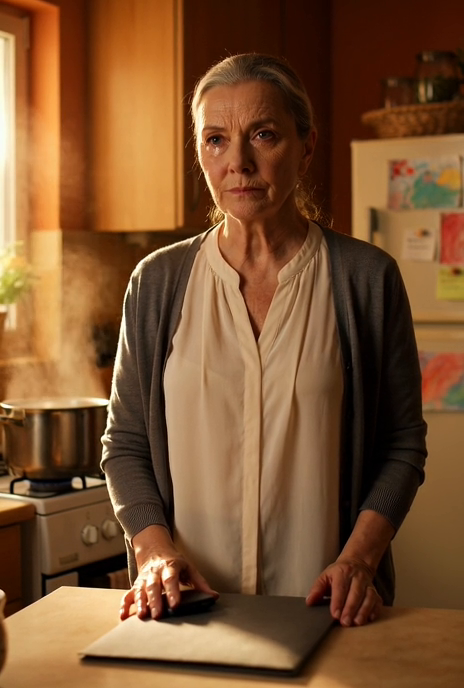
short recordings showed my mother speaking clearly in our kitchen.
In one, Vanessa and an unfamiliar man discussed documents spread across the table.
The files contained enough to alarm me, but not enough to understand the full scheme.
I contacted an elder-law attorney named Sarah Kim from the airport during my trip home.
She advised me to preserve the originals, avoid confronting anyone until Mom was safe, and call emergency services if I discovered immediate danger.
I intended to follow that advice.
But hearing my mother begging from upstairs tested every bit of restraint I possessed.
***
Vanessa had married me when I was twenty-five.
Back then, she worked for a real estate brokerage.
She was ambitious, energetic, and unusually good at remembering the small things people liked.
She remembered my favorite coffee.
My mother’s birthday.
The anniversary of my father’s death.
When Dad passed away in 2019, Vanessa arranged the funeral reception without being asked.
For years, I believed she loved Mom almost as much as I did.
Two years before my deployment, Margaret underwent knee surgery and moved into our house temporarily.
The arrangement became permanent after she sold her old home.
She contributed toward household expenses, tended the garden, and treated our place as her own.
There was another reason Mom stayed close to Fredericksburg.
She owned thirty-one acres of orchard land outside Culpeper.
My grandparents had purchased the property in the 1960s.
My father maintained its aging apple trees until his health declined, and Mom refused several offers to sell after his death.
“Land doesn’t forget the people who cared for it,” she liked to say.
I knew developers had become interested in the area.
I didn’t know one had recently offered more than three million dollars for her property.
That discovery would explain almost everything.
After the neighbors left, I carried my duffel bag inside and asked Vanessa whether Mom had eaten dinner.
“She refused her food again,” Vanessa said.
“Don’t worry.
I’ll handle it.”
“I’d like to see her.”
“Tomorrow morning.
She’s agitated whenever people disturb her routine.”
I glanced at the staircase.
“I’m her son.”
“And I’m the person who’s been here dealing with this every day.”
The resentment in her voice appeared so suddenly that she seemed surprised by it herself.
Then she softened.
“I’m sorry, sweetheart.
I’m exhausted.”
I let the conversation end.
During dinner, I noticed that the house had changed.
Mom’s family photographs were gone from the hallway.
Her favorite armchair was missing.
A small television stood where her bookshelf had been.
And on the kitchen counter sat a thick folder labeled with her name.
Inside were unsigned power-of-attorney forms, a list of assets, and an information sheet describing adult guardianship proceedings.
A handwritten note in Vanessa’s familiar script read: Doctor, 8 a.m.
Documents ready.
I put everything back exactly where I found it.
“You’ve been busy,” I remarked.
Vanessa exhaled.
“You have no idea.”
“I appreciate what you’ve done for her.”
She reached across the table.
“I knew you’d understand once you got home.”
The look on her face wasn’t relief.
It was confidence.
She believed she had already won.
***
At 10:43 that evening, Vanessa went downstairs to make tea.
I entered our bedroom and searched the jewelry box she kept on her dresser.
Beneath the velvet