presenting a tragedy.
He told the court I had become overwhelmed by my investments.
He said Nicole had stepped in to help.
He described my sister as a devoted family member who had spent years “supporting an increasingly isolated sibling.”
Then he produced the document.
A property gift agreement.
My company letterhead appeared at the top.
My full legal name appeared throughout.
At the bottom was a signature that looked exactly like mine.
Beside it was what appeared to be a Washington notary seal.
Bell handed copies to the court.
“Ms.
Manning voluntarily transferred beneficial ownership of 48 Hollow Pine Road to my client approximately five months ago,” he said.
“The transfer was made in recognition of years of assistance provided by Mrs.
Irving in maintaining the property and helping Ms.
Manning manage her affairs.”
Nicole turned toward me.
Her expression was almost peaceful.
She thought she had won.
Bell continued.
He said I had later regretted my decision and refused to cooperate with recording the final deed.
He described Hollow Pine as my principal asset.
That sentence caught Judge Brown’s attention.
She looked down at the papers.
“Principal asset?”
“Yes, Your Honor.”
The judge looked at me.
“Miss Manning, how many properties do you currently own?”
Chris smiled.
I stood.
“Twelve, Your Honor.”
Silence.
Judge Brown’s eyebrows rose slightly.
“Twelve properties?”
“Seven residential rentals, two mixed-use buildings, two renovation properties, and Hollow Pine.”
She looked back at Bell.
“And you are characterizing Hollow Pine as her principal asset?”
Bell shifted.
“It is, to my understanding, her most personally significant property.”
“That is different from a principal financial asset.”
He didn’t answer.
Judge Brown studied me again.
“Miss Manning, why would you give this property to your sister?”
“I wouldn’t.”
Nicole’s smile vanished.
I continued.
“I’ve never authorized her to manage Hollow Pine, never promised her ownership, and never signed that agreement.”
Bell sighed theatrically.
“Your Honor, naturally she disputes it now.”
I opened my briefcase.
“I dispute it because it’s forged.”
My mother made a faint sound behind Nicole.
Chris leaned toward his wife.
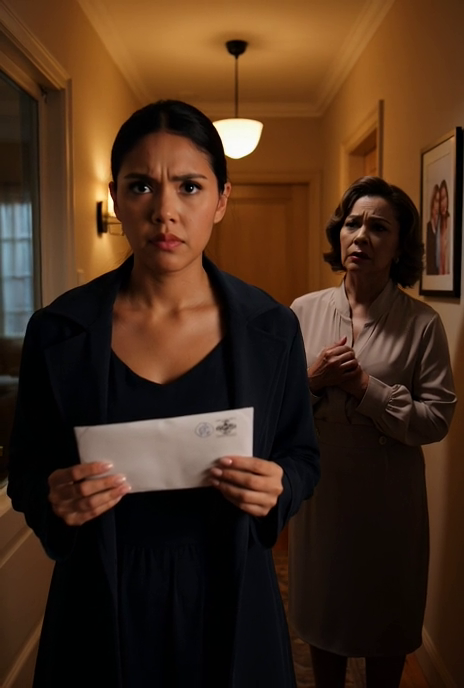
I removed a sealed envelope.
The first document was a declaration from Rebecca Sloan, the notary whose name appeared on Nicole’s agreement.
I had called Rebecca two weeks earlier after obtaining a copy during discovery.
She had been confused.
She had never met Nicole.
More importantly, she had never notarized any transfer involving Hollow Pine.
Her declaration stated that the impression on the document did not match the seal registered to her current commission.
Bell read the first page twice.
Then I produced a report from a forensic document examiner.
The supposed signature on the gift agreement matched one from an old contractor authorization I had signed three years earlier.
Not merely similar.
Identical.
Same pen lift.
Same tiny hesitation in the capital T.
Same microscopic ink gap caused by a damaged roller in the scanner used at my former office.
According to the examiner, the image had almost certainly been copied digitally and placed on the newer document.
Judge Brown’s expression changed.
Not dramatically.
That was worse.
She became very still.
Chris stood.
“This is ridiculous.
Anyone can pay an expert to say anything.”
The bailiff moved toward him.
“Sit down, Mr.
Irving,” Judge Brown said.
He sat.
Then I produced the access log.