we please talk privately?”
“First,” I said, “I’d like you to look at something.”
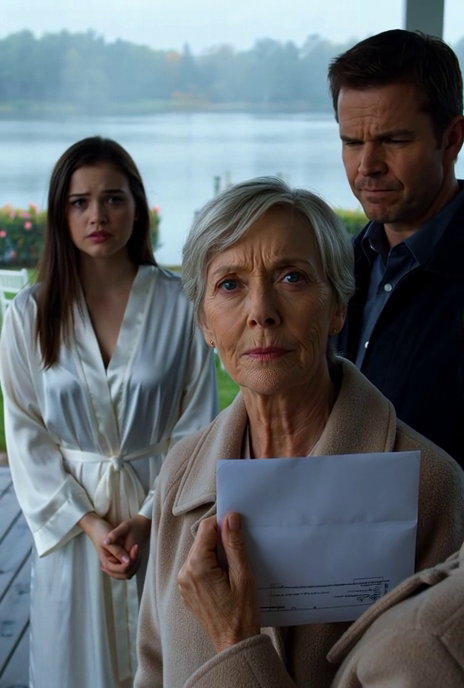
Nadia handed him the property-use agreement.
He read the first page.
Then the second.
His jaw tightened.
“That’s not Mom’s signature,” he said.
Hope stirred in me for one brief second.
Then Nadia turned the document over.
“Is this your signature on the witness line?”
Caleb stared at the page.
He didn’t answer.
“Caleb?” I asked.
His eyes closed.
“Yes.”
“Did you see me sign that agreement?”
Silence.
I heard the wind moving through the sea oats beside the fence.
“No,” he finally said.
The answer was barely audible.
“Then why did you sign as a witness?”
His face crumpled with shame.
“Because I thought we could explain it to you afterward.”
I looked at him for a long moment.
There are betrayals that arrive like thunder.
And there are betrayals that arrive in your own child’s voice, spoken so softly that the people around you have to stop breathing to hear them.
“You knew?” I asked.
“Not everything.
I knew about the first retreat.
Mallory said the business needed a venue and that we’d be able to pay you once bookings came in.”
“Did you ask me?”
“No.”
“Did you know she was signing my name?”
He swallowed.
“I knew she had written it on the agreement.
I told myself we’d replace the paperwork when you agreed.”
Mallory stepped forward.
“Caleb, you don’t have to tell her all our private business.”
He turned toward her.
“It’s her house.
There shouldn’t have been any private business involving it.”
That was the first useful thing my son had said all evening.
But it didn’t undo what he had done.
Willa approached the table with her own folder.
“There’s something you should see,” she told Nadia.
Inside were printed invoices for the current weekend and a schedule of future retreat installments.
The guests had been asked to authorize additional payments the following morning for optional memberships and priority access to future coastal events.
Mallory had not simply borrowed my home for one weekend.
She was building a continuing business around it.
“You planned to keep doing this,” I said.
Mallory’s eyes flashed.
“I built something successful out of a house that sits empty most of the year.
You should be grateful.”
I looked at the guests, then at my son.
“Grateful for what? Having my name copied onto a document? Being told I live in a care facility? Being ordered out of the place I worked thirty-one years to afford?”
“We needed the money,” she snapped.
At last, something real emerged.
Caleb looked down.
Their own finances were worse than I knew.
Mallory’s previous event business had lost an important venue contract.
She had accepted deposits for events she could no longer host, and her business credit account was overdue.
Caleb had been quietly paying bills from their household savings.
They were afraid they might lose their home.
And instead of telling me the truth, they had decided to use mine.
“Why didn’t you ask me for help?” I asked Caleb.
His answer made the entire situation clearer.
“Because I knew you might say no.”
I nodded.
“Then you knew it was my decision to make.”
He had no response.
Mallory’s mother began gathering her belongings from the