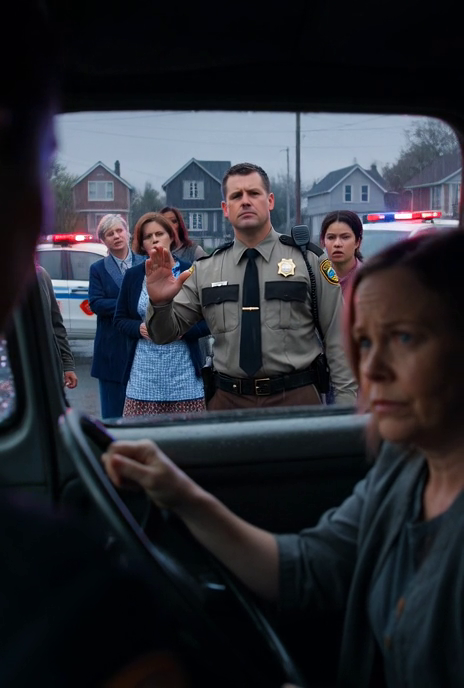
came to make sure my daughter gets home safely.”
Claire requested that they leave.
When Russell refused, hospital security escorted the three visitors toward the elevators.
Nathan glanced back at his wife.
“You’ll regret this.”
Claire did not answer.
But I felt her hand become steady inside mine.
That small change meant more to me than anything I had achieved that afternoon at the military ceremony.
Once they were gone, a patient advocate named Maria Ellis joined us.
She explained Claire’s options for preserving medical evidence, discussing her injuries with investigators, arranging confidential support, and finding somewhere safe to stay.
Claire consented to photographs of her injuries and spoke privately with Maria.
I waited in the corridor while they talked.
It was one of the hardest things I had done that night.
Every instinct told me to remain beside my daughter, but protecting her also meant allowing her control over decisions that others had spent months taking away.
When I returned, Claire told me something that made the situation even more serious.
“They wanted Harbor House, Mom.
Nathan said his family couldn’t afford to lose the hotel financing.”
I remembered a conversation from six months earlier.
At a charity dinner, Eleanor had mentioned that the Whitmore family’s newest hotel project would become the centerpiece of Norfolk’s waterfront redevelopment.
She had described it as a two-hundred-million-dollar investment.
Later, Claire told me Nathan had been working constantly and rarely sleeping.
He had claimed that every delay cost the family tens of thousands of dollars.
I now wondered how much of that wealth existed only on paper.
At 10:46 p.m., my attorney, Rebecca Sloan, arrived at the hospital.
Rebecca and I had been friends for more than twenty years.
She was one of the few people who could tell me I was wrong without expecting an argument.
She listened to Claire’s account, reviewed the available documentation with her permission, and immediately distinguished two problems.
The first concerned Claire’s physical safety and the alleged crimes committed at the estate.
The second concerned the property the Whitmores were desperate to control.
Rebecca opened her laptop.
“Let’s check whether they’ve filed anything against Harbor House.”
She accessed the county’s public land records.
Within minutes, she stopped typing.
“Victoria, I need you both to look at this.”
An easement had been recorded that afternoon at 4:12 p.m.
It granted Whitmore Development Group permanent access across a substantial portion of Harbor House’s eastern property.
The document showed Claire’s signature.
A notary named Daniel Rusk had certified that Claire personally appeared before him the previous day at 3:10 p.m.
Claire stared at the screen.
“I never signed that.”
“Are you certain?” Rebecca asked gently.
“Absolutely.
Nathan showed me papers.
I refused.
His brother locked the doors when I tried to leave.”
Rebecca downloaded the available filing information and requested a certified copy through the appropriate county office.
“A recorded document isn’t automatically genuine,” she explained.
“But it can create serious problems until its validity is challenged.
We need to move quickly.”
My phone vibrated.
It was a message from an unfamiliar number.
The sender identified herself as Grace Moreno, a housekeeper employed at the Whitmore estate.
Her message contained a photograph of three heavy construction machines parked near the Harbor House entrance.
The accompanying words were simple.
“They’re starting